
Thyroid scandal:
Millions of women with an underactive thyroid have been treated WRONGLY for years and are suffering for nothing.
At 54 I was overweight, constantly exhausted and one step away from losing my job. Then I discovered the shocking truth about synthetic thyroid hormones, and within a few months I lost 4 kilos, got my energy back and finally felt like myself again.


Constant tiredness, even though you spent ten hours in bed the night before.
Your weight keeps creeping up, however little you eat.
Swollen legs that are so puffy by the evening that your socks dig in.
Muscles and joints that already ache in the morning, as if you were 90.
Sleep that no longer restores you.
No matter how long you sleep. Sound familiar?
Then you are like millions of other women with an underactive thyroid in the UK.
Women who hear from their doctor again and again:
“But your results are normal.”
Women who dutifully take their tablet and still feel unwell every single day.
Women who at some point start to believe that this is just how it has to be.
And who don’t know that everything doctors have been telling them for years is based on one big mistake.

In the morning I would stand in front of the mirror and flatten my stomach with both hands.
I tried to picture what I had looked like two years earlier.
When I tied my shoes, my stomach got in the way.
And the worst part:
In the office there were colleagues with the same diagnosis.
Underactive thyroid. The same tablets. And yet they were slim.
And me?
I would lie awake at three in the morning with my thoughts racing, then at seven I could barely drag myself out of bed, dropping with exhaustion.
Things were getting worse at work too.
I, who for years had been known for razor sharp journalistic precision, suddenly needed three attempts to write a single paragraph.
My boss once said carefully: “You seem a bit… absent lately.”
Three months later the unthinkable happened:
I missed a deadline.
For the first time in a 25 year career. My boss didn’t say anything.
But from that day on, the big stories went to other colleagues.
And me?
I sat in my office, looked out of the window and wondered when exactly I had stopped being myself.

When exactly did I start accepting this life as normal?
20 years…
For 20 years I dutifully took my tablets.
For 20 years I believed every doctor who told me my results were “completely normal”.
For 20 years I told myself it just had to be this way: my age, hormones, stress.
And for 20 years I overlooked what was right under my nose.
Until six months ago.
When my boss put the last story of my life on my desk and, without knowing it, saved my life.

Because back then I didn’t yet know:
An underactive thyroid sounds harmless.
But it isn’t.
Your thyroid isn’t just some little organ in your neck. It is the control centre of your whole body.
It controls your metabolism.
It controls your energy.
It controls your hormones.
It controls whether you feel warm, how fast your digestion works, how well you sleep and even how you feel.
When the thyroid suffers, the whole body suffers.
And this is exactly the problem that almost no GP explains to their patients:
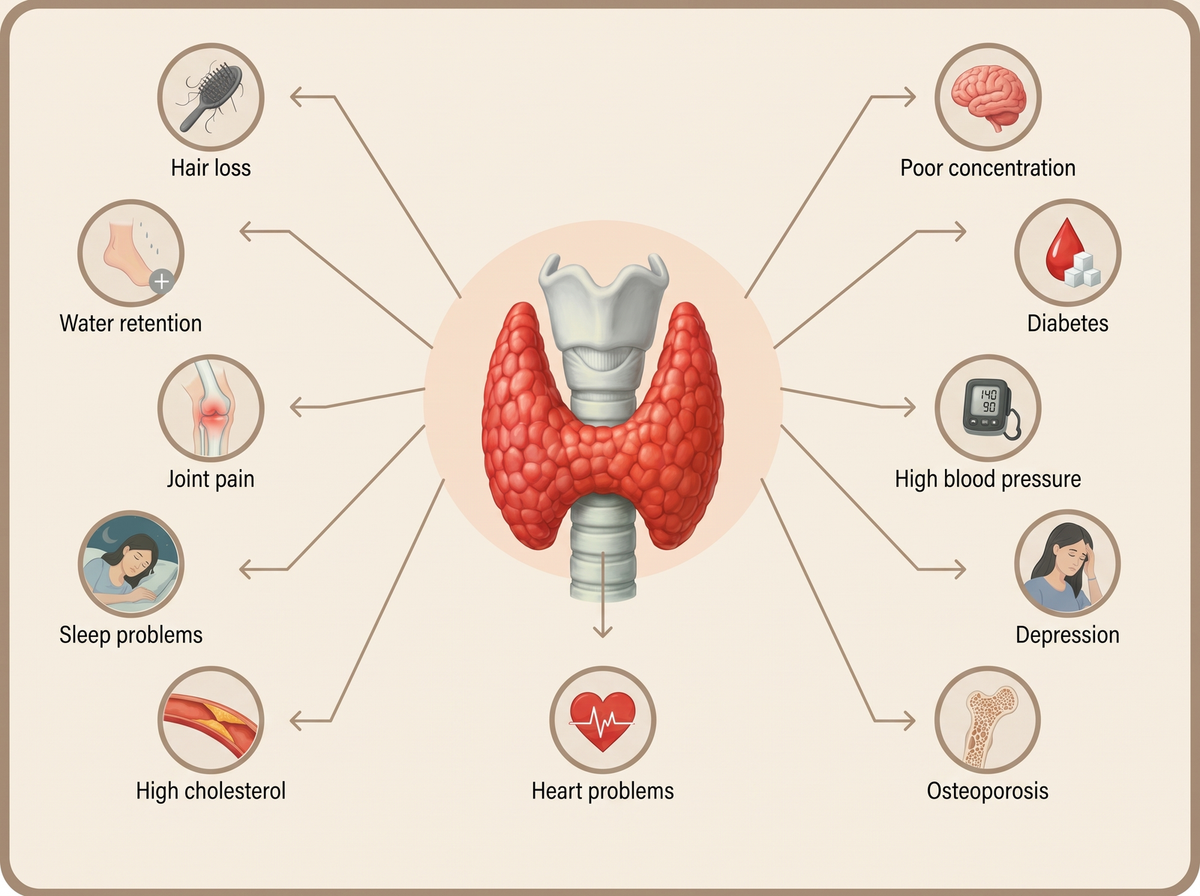
Almost ALL of your symptoms ultimately come from one place: your thyroid.
And I don’t just mean tiredness and weight gain.
I mean:
- hair loss and brittle nails, because your cells no longer get enough energy
- water retention in your hands, legs and face, because your metabolism is running in slow motion
- joint pain that feels like rheumatism, even though you don’t have rheumatism
- sleep problems and waking up at night, because your hormone balance is out of kilter
- high cholesterol, because your liver is less well supplied with nutrients
- heart palpitations, as a side effect of your tablets
- poor concentration and forgetfulness, because your brain is no longer properly nourished
- high blood pressure, because your blood vessels no longer work properly without active thyroid hormone
- low mood, because your brain can no longer make enough happiness hormones
- weaker bones (osteoporosis), because your body no longer stores calcium properly
- and even type 2 diabetes, as a long term consequence of an underactive thyroid treated wrongly for years
Yes, you read that right.
All of these complaints are often the consequence of a wrongly treated underactive thyroid.
But most doctors treat them as ten different problems.
Cholesterol tablets from one doctor.
Sleeping tablets from the next.
Painkillers for your joints from a third.
And on top of that, ever higher doses of thyroid medication.
That is exactly what happened to me for 20 years.
And it is exactly what is happening right now to millions of women in the UK.
Only when I understood that everything is connected could I finally change something.
Today, a year later, my life is almost unrecognisable:
I wake up rested, without an alarm.
I’ve lost 9 kilos, without dieting, without exercise.
My hair is thick enough again for a proper ponytail.
My cholesterol is back in the normal range for the first time in ten years.
How did I do it?
I stopped blindly trusting my doctor and started doing what I had trained to do my whole working life:
Dig deeper.
What I discovered first shocked me, then made me furious, and in the end saved my life.
In this article I’m sharing all of it with you.
In this report you’ll learn:
why the doctor who helped write the official rules for treating our thyroid is now publicly speaking out against that very treatment.
why you will never really feel better despite your daily tablets if you carry on like this.
why medication often leads to heart palpitations
which inconspicuous organ in your body is right now making your tablets work in vain.
how two simple but crucial steps can finally get you out of the vicious circle and give you back your quality of life
Sometimes in life there is one moment that changes everything.
Maybe this article is your moment.
The moment when you finally understand why your tablets haven’t been helping you for years and what you really need to do to feel better again.
If no one has been able to really help you so far, please stay with me now.
Because what I’m about to tell you changed my life.
And it will probably change yours too.
It was a Tuesday morning in May when my boss called me into his office.
I knew that look. I had seen it often enough with colleagues who packed up their things afterwards.
“Lina, I have to be honest. The last six months have been difficult. We have to let some people go and you’re on the list.”
25 years of career. Over.
I sat there and couldn’t even answer.
Then he pushed a folder towards me.
“But I’m giving you one last chance. We need a big cover story. Underactive thyroid: around 3 million people in the UK take thyroid medication. In the US a book by a professor is doing the rounds that questions everything we knew about treatment. Nobody here has written about it yet. You have eight weeks.”
My heart jumped.
Underactive thyroid.
My condition.
The condition I had lived with for 20 years and, if I’m honest, still didn’t understand at all.
At home I closed the door of my study, switched off my phone and opened the folder.
Inside: a few printouts from American media.
A recommended book.
And the name of a man I had never heard of before.
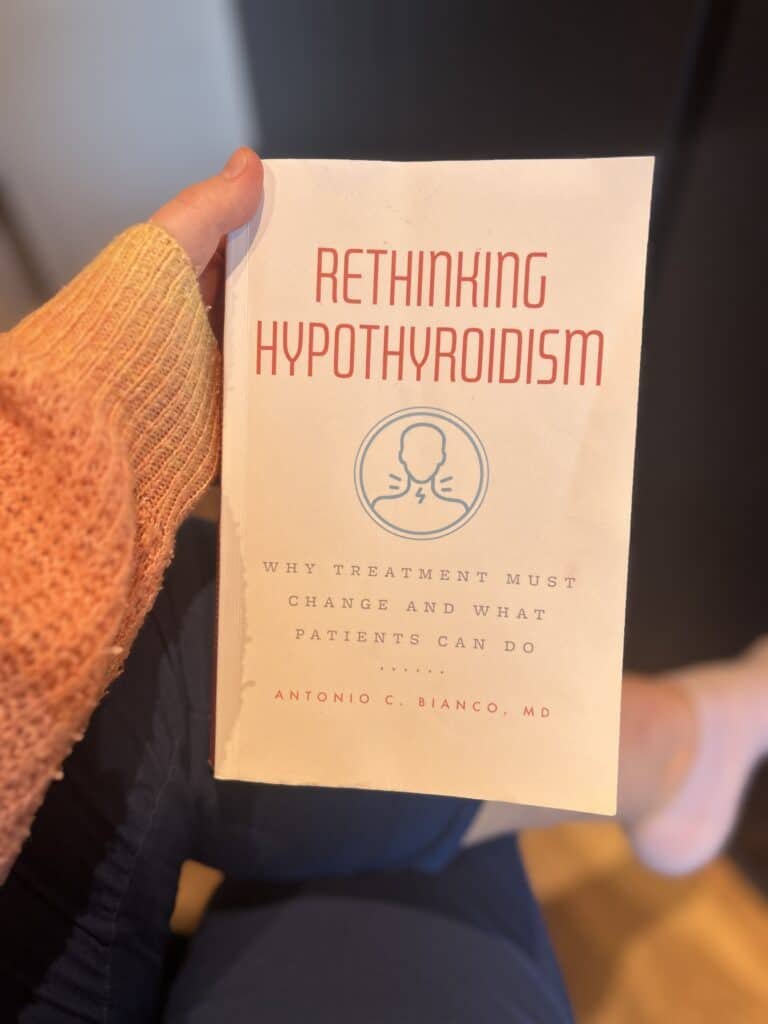
Antonio Bianco.
What I learned about him over the next few hours kept me awake all night.
Because this man wasn’t just any doctor.
He helped write the official standard therapy for an underactive thyroid.
The very therapy my doctor had been treating me with for years.
The very therapy that is used today to treat every woman in the UK.
And this very man has now said publicly:
“We were wrong.”
What is standard therapy?
Standard therapy is the official rulebook used worldwide today to treat every patient with a thyroid condition.
Every GP. Every endocrinologist. Every clinic.
Around 3 million people in the UK alone take thyroid medication prescribed according to this rulebook.
And this rulebook was co-written by Antonio Bianco.
And today he himself says: it is wrong.
In other words: millions of women are right now being treated according to a system that its own creator considers a failure.

Antonio Bianco is one of the most influential thyroid doctors in the world.
Professor at the University of Chicago.
For many years president of the largest thyroid association in the world.
Winner of the highest award a thyroid researcher can receive.
And the man who, ten years ago, helped write the official treatment guidelines, the guidelines every doctor today uses to treat their thyroid patients.
And this very man has published a book.
What he admits in it knocked me off my feet.
For decades Bianco was firmly convinced:
If a patient takes synthetic thyroid hormone, her thyroid is taken care of. Full stop.
That is what he was taught at university, and what he himself wrote into the official guidelines.
But then something happened that changed everything. Bianco realised that he had been wrong all his life.
That synthetic thyroid hormone alone is not enough. That millions of women keep suffering despite their tablets, and precisely because of their thyroid.
In his book he writes:
“For years I told my patients that their complaints had nothing to do with their thyroid. Today I know I was wrong.” And: “The guidelines I helped to write are failing millions of patients.”
Let that sink in.
The man who created these guidelines now says himself:
these guidelines are wrong.
I sat at my desk staring at the screen and could hardly believe it.
Because in his book Bianco explains exactly WHY he was wrong.
And that is what I’m summarising for you now.
Because what Bianco writes explains, for the first time, why we thyroid patients don’t get better despite our tablets.
What comes next are the most important 3 minutes of this entire article.
If you understand this, you will grasp for the first time in your life what is really going on in your body.
You will understand why your tablets aren’t working.
Why your results still look “normal”.
And above all: what you need to do to finally feel better again.
I promise you: no doctor has ever explained this to you.
And I’ll try to explain it so simply that you will never forget it.
T4 and T3: this is the big mistake
Your thyroid produces two hormones:
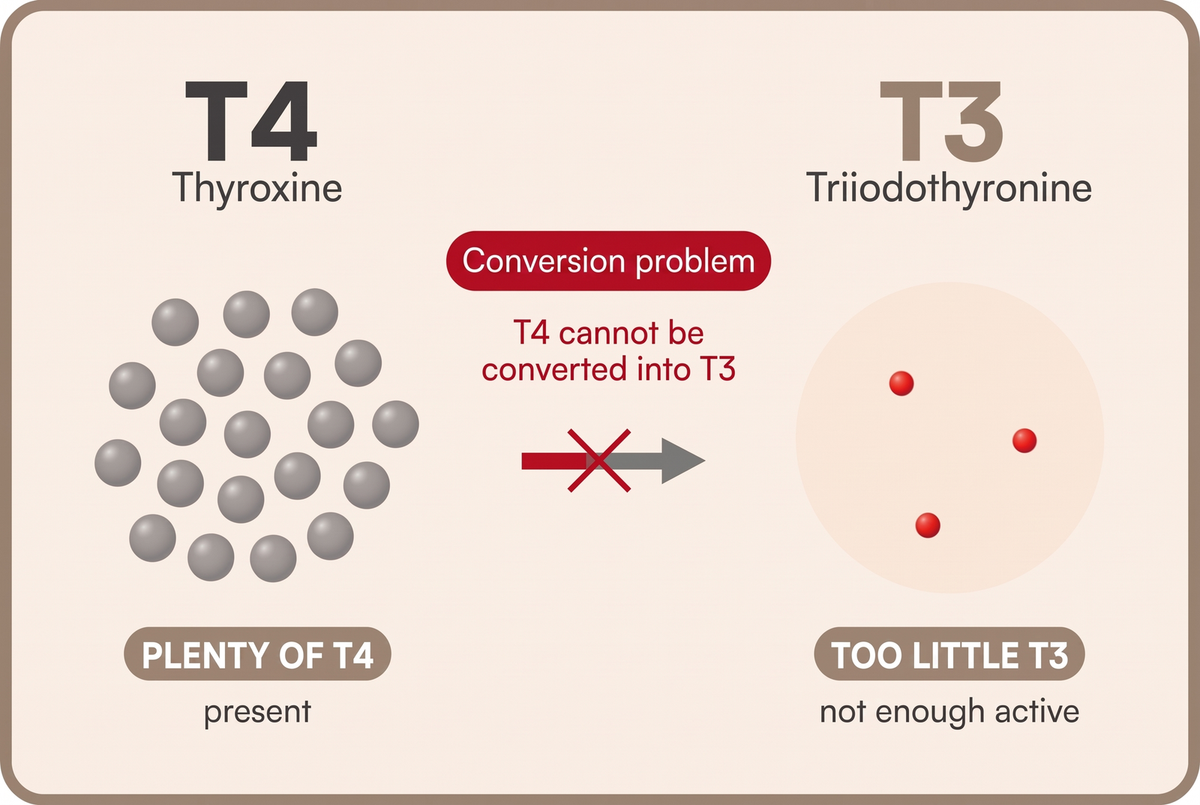
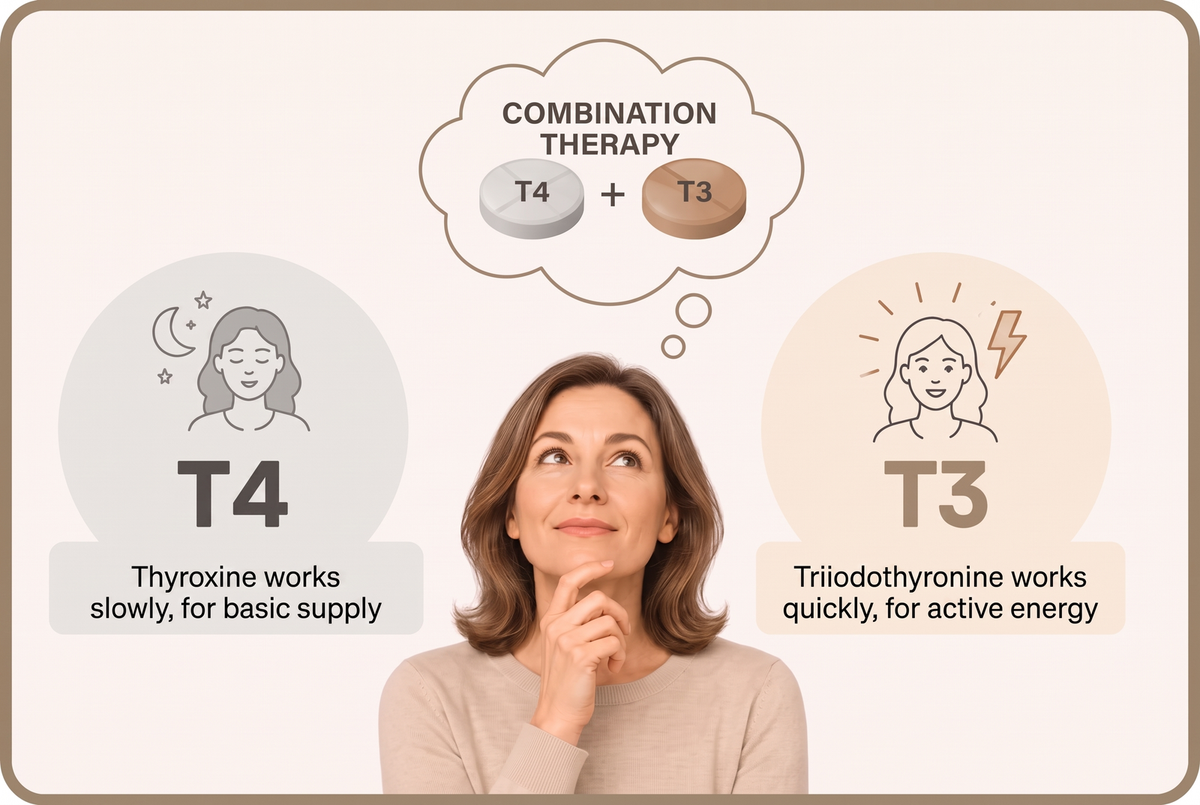
- T4 is the inactive form. It simply circulates in your blood and does nothing.
- T3 is the active form. It is what powers your body with energy. It is what gets your metabolism going. It is what makes you feel alert and full of life.

Now hold on tight:
The thyroid medication you swallow every morning contains only T4.
In other words, the inactive form of thyroid hormone.
For you to feel better, your body first has to convert T4 into T3.
And this is exactly where the problem starts.
Conversion disorder
Now comes the moment that changes everything.
The sentence I didn’t hear from a single doctor in 20 years.
Ready?
In many women with an underactive thyroid, this very conversion of T4 into T3 no longer works properly.
The body simply can’t manage to turn inactive T4 into active T3.
The technical term for this is a conversion disorder.
And Bianco writes clearly in his book:
If your body can’t convert T4 into T3, even the best thyroid medication in the world won’t help.
You can take as many tablets as you like.
The hormone simply stays inactive in your blood.
Your results look great.
But because you are missing T3, nothing reaches your cells.
Self-test: do you have a conversion disorder?
If at least two of these points apply to you, you are very likely to have a conversion disorder:
☐ Your blood results are supposedly “normal”, but your symptoms won’t go away
☐ You have high cholesterol
☐ You have a fatty liver
☐ You are always cold, with cold hands and feet
☐ You put on weight even though you eat little
☐ Despite medication, your body temperature stays clearly below 36.8 degrees
If you recognise yourself here, the problem isn’t your thyroid.
It’s a conversion disorder.
The danger of a conversion disorder
A conversion disorder always means you have too little T3 in your body.
T3 is the most important thyroid hormone, because it powers almost every organ and many important enzymes in the body.
A lack of T3 is the reason so many different symptoms appear with an underactive thyroid.
This is really important to understand:
Your gut problems, your high blood pressure, your diabetes, your sleep problems: all of these conditions develop over the years as a consequence of an underactive thyroid.
Because your body isn’t getting enough of the hormone T3.
The following connections show this clearly:
🚨 Too little energy (T3) for the liver = high cholesterol, because breaking down cholesterol in the liver no longer works
🚨 Too little T3 = slow metabolism, which makes controlling your weight almost impossible
🚨 Too little T3 for the gut = digestive problems, because your gut no longer gets a proper blood supply
🚨 Too little T3 = constantly cold hands and feet, because your body has poorer circulation
🚨 Too little T3 = greater risk of diabetes, because a lack of T3 lowers the gene expression of the protein that transports glucose. The result: blood sugar rises faster
🚨 Too little T3 = the receptor for the sleep hormone melatonin is weakened, which makes good sleep harder
🚨 Too little T3 = the receptor for the happiness hormone serotonin is weakened. A lack of T3 can therefore lead to depression.
🚨 Too little T3 = the luteinising hormone (LH), which triggers ovulation, is weakened. That is why a lack of T3 can also be a cause of infertility.
🚨 Too little T3 = calcitonin, the hormone that controls how calcium is stored in the bones, is weakened. A lack of T3 therefore leads to weaker bones (osteoporosis)
Suddenly all my failed attempts made sense too
Reading Bianco’s book, the scales fell from my eyes and I understood why nothing I had tried in 20 years had ever really worked.
A higher dose of thyroid medication
Pointless! If your body can’t convert T4, more T4 won’t help either.
Expensive supplements from adverts
Money down the drain! They all support the thyroid, but the thyroid itself isn’t the problem at all. The problem is that your body isn’t converting T4 into T3.
Exercise to lose weight
It only wore me out. Without active T3 your body has no energy for exercise and you just burn yourself out even more.
Changing my diet
As long as your metabolism is running in slow motion, you can eat whatever you like and you still won’t lose weight.
For 20 years I had been turning the wrong dials.
Nobody told me where to really start.
Nobody told me:
It’s not your thyroid that is failing. It’s the T3 your body is missing.
But now that I finally knew what the problem was, there was only one logical question left:
How do I give my body the T3 it is missing?
Bianco had the answer in his book.
It was so simple that I could barely sit still as I read it:
If your body can’t convert T4 into T3 on its own, then simply give it T3 directly.
Not instead of your thyroid medication. In addition to it.
T4 plus T3 combined.
This is called combination therapy.
I stood up, paced back and forth in the kitchen and could hardly breathe with excitement. This was the answer.
After 20 years.
The solution was so simple: I just needed extra T3.
My doctor would prescribe it for me.
That same night I wrote a list of questions.
I printed out the studies.
The next morning at 8:00 I rang the surgery.
I was more excited than I had been in years.
I was sure: This is it. Finally.
Three days later I was sitting opposite my doctor.
I explained everything to him. Calmly. Factually. Like a journalist.
He listened, politely, patiently, almost sympathetically.
Then he leaned back and said:
“Mrs Krawiecka, I understand you. But that is not standard treatment in the UK. I can’t prescribe it for you. Your results here are very good and I won’t do anything that goes beyond the guidelines.”
He said it kindly. But firmly.
I left the surgery and, while still in the car, rang the first endocrinologist I could find.
Waiting time: four months.
I called a second clinic. Three months and a cost of £700 to £1,300 a year.
The third: “We don’t treat patients with combination therapy.”
I dug around all night. This time not into the thyroid.
Into the UK health system.
What I found was depressing:
The official UK guidelines do not recommend combination therapy: they see no clear advantage over thyroid medication containing T4 alone.
Dosing T3 is more complicated than dosing T4. T3 acts faster and is broken down faster. Getting it right takes a lot of experience, regular check-ups and close monitoring.
That is why most GPs don’t prescribe T3 or a combination product: they stick to the guidelines and avoid the hassle. Anyone who still wants it usually ends up in specialist private clinics as a self-paying patient, with high yearly costs.
I sat at the kitchen table at midnight.
Slowly it dawned on me:
The only therapy that could really help me, no doctor in the UK would prescribe for me.
Not because it would be wrong. But because the system doesn’t allow for it.
I had been so close.
I had found the answer.
And still I couldn’t have it.
For the first time in weeks I cried.
Not out of anger. Out of despair.
At that moment I was one step away from giving up on everything.
The story. My job. My belief that things would ever get better.

Was this the end?
It was a few days later.
I was standing in the kitchen in the morning washing up the breakfast dishes.
It was one of those days when I had barely dragged myself out of bed.
In the background a podcast was playing in which several thyroid experts were discussing the latest findings.
I was half listening, half thinking about the story I still hadn’t written.
Then the name Antonio Bianco came up.
I put down the tea towel, turned up the volume and sat down at the kitchen table.
What the experts said next made the tea towel slip from my hand.
They were talking about a completely different approach that I had never heard of before.
An approach that could solve most thyroid problems, without extra T3.
Without combination therapy.
Without a private clinic at your own expense.
The approach was so simple that for a moment my mind went blank:
Instead of artificially giving the body the missing T3, we simply get the body to convert T4 into T3 on its own again.
In other words, we remove the conversion disorder. At its source.
And one of the experts even said that for most patients this is actually a better, more natural way.
I sat there trying to take in what I had just heard.
Suddenly it all made sense:
If my body converts T4 on its own again, then I don’t need extra T3.
Then I don’t have to swallow perfectly dosed T3 tablets two or three times a day.
Then there is no hormonal rollercoaster, no crashes when I forget a tablet.
Then my body does what it was made to do:
It takes the T4 I swallow in the morning and converts it into T3 on its own, evenly throughout the day, in exactly the amount it needs at that moment.
A natural, steady supply of the active hormone.
The way it is supposed to work. For the first time in weeks I had hope again.
But one crucial question remained:
How exactly do you get the body to convert T4 into T3 again?
And that is when the sentence came that changed everything for me.
The liver
One of the experts explained:
“Up to 80 percent of the conversion of T4 into T3 doesn’t take place in the thyroid at all. It happens in the liver.”
I sat there. Frozen.
In the liver.
Had I heard that right?
I rewound the recording. Listened to the sentence again.
Up to 80 percent of the conversion takes place in the liver.
Not in the thyroid.
In an organ that absolutely nobody thinks about when it comes to the thyroid.
And with that it became clear where the conversion disorder really comes from:
The liver can no longer keep up with converting T4 into T3.
But why does conversion in the liver stop working?

Why the liver is almost always overloaded today
What most people don’t know:
The liver is your body’s treatment plant.
Every day it has to filter every harmful substance out of your blood:
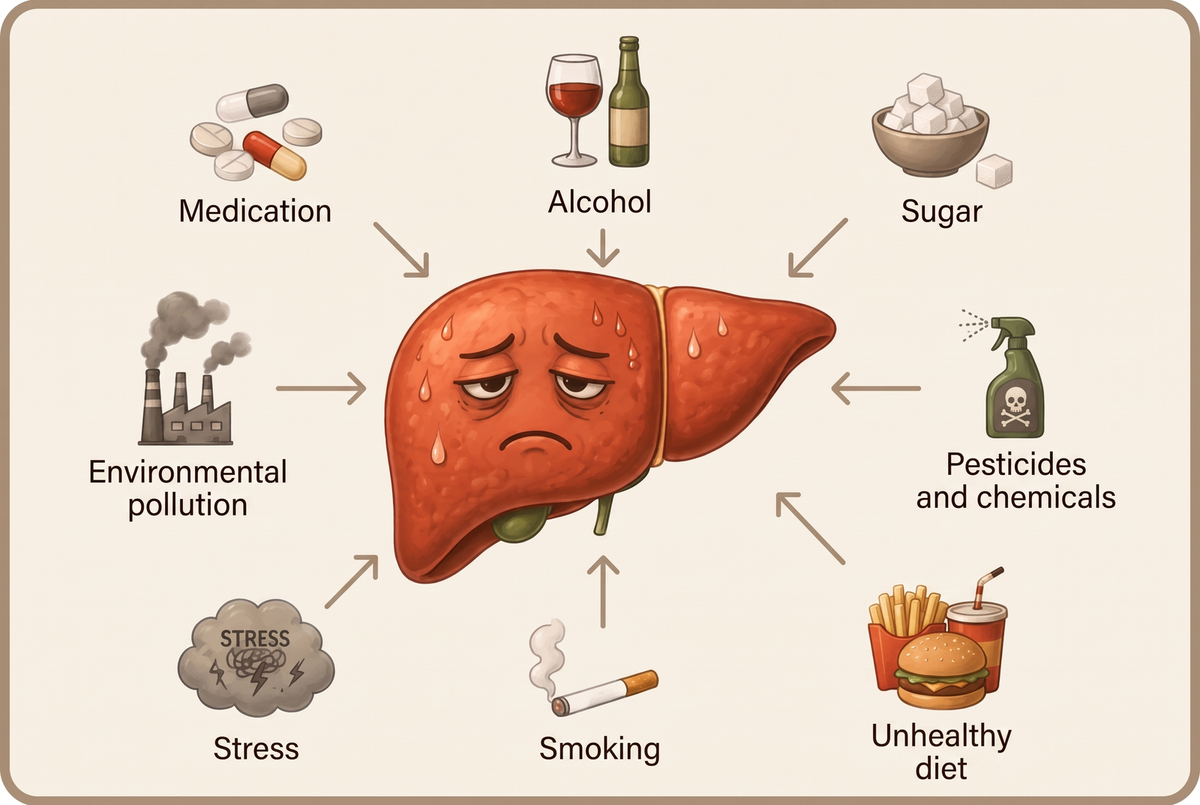
Medication, alcohol, sugar, pesticides from food, microplastics, exhaust fumes. It even has to break down stress hormones.
Everything that doesn’t belong in your body lands on your liver’s desk.
And this is exactly the problem:
100 years ago our grandmothers’ livers had a fraction of this workload.
Today it works at its limit every single day.
And when an organ works at its limit, it first does what is essential for survival: detoxify.
Everything else takes a back seat.
Including the conversion of T4 into T3.
What the studies show:
Up to 1 in 3 people in the UK have early stage fatty liver, and many don’t even know it
Almost half of UK adults have raised cholesterol
The liver has no pain receptors. So it suffers in silence, without you feeling it.
Suddenly everything made sense.
An overloaded liver no longer converts T4 into T3.
In me. In you. In millions of women in the UK.
That is exactly why our tablets don’t work, however high the dose.
Then came the sentence in the podcast that knocked me off my feet.
One of the experts said:
“The liver is one of the few organs in the human body that can fully regenerate, if you give it the right nutrients.”
Let that sink in.
The liver heals itself.
It is the only organ in your body with this ability.
Even after decades of overload, with the right nutrients it gets its strength back.
And when the liver is running at full power again, it can finally do what it was made to do:
Convert T4 into T3.
Just like in a “healthy” person.
Just like it worked for me 20 years ago. In the podcast the experts then explained very concretely how it works.
They talked about two steps that have to work together:
Step 1:
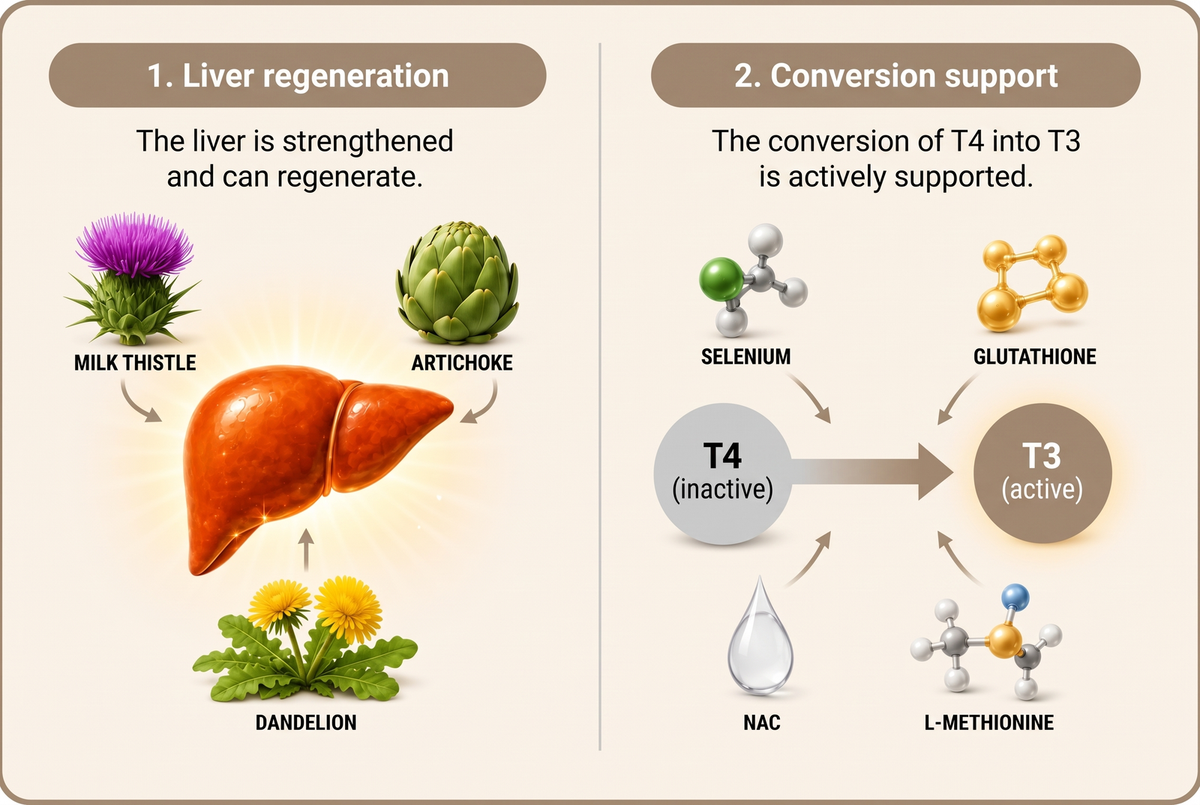
The liver has to be actively regenerated so that it has the strength to convert thyroid hormones at all.
Step 2: The body has to be supplied with the right nutrients, exactly the substances it really needs for the conversion of T4 into T3.
Two steps. Nothing more.
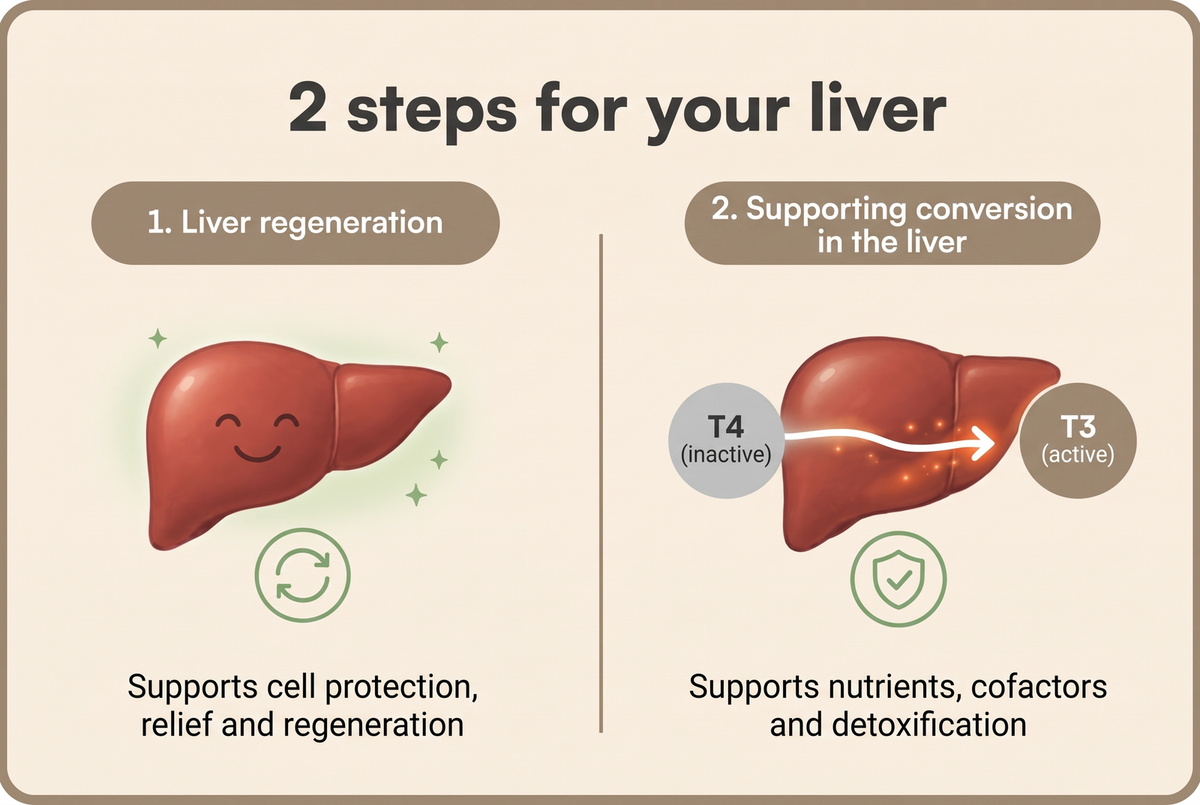
If I manage these two steps, my liver will regenerate, conversion will start again and my body will finally do what it was made to do again.
And that would mean:
- Finally having energy again. Finally sleeping through the night again.
- Finally losing weight again, without wearing myself out every day.
- Finally sleeping until morning again, without constantly waking up at night.
- Finally thicker hair again. Better skin.
- Finally recognising myself in the mirror again.
Summary so far
Your body needs the active thyroid hormone T3
But thyroid medication only supplies the inactive hormone T4
The conversion of T4 into T3 mainly takes place in the liver
If you still have symptoms despite medication, you are most likely dealing with a conversion disorder
The solution is NOT to increase your dose of medication.
How do I get my liver going again?
The podcast gave me the key words:
Liver. Regeneration. Nutrients.
Now it was my turn.
That night I opened my laptop.
What I learned over the next two weeks changed my understanding of the thyroid forever.
Because the evidence had been on the table for a long time: in renowned scientific journals, in clinical studies from all over the world, in years of university research.
There were hundreds of studies on liver regeneration.
And yet in 20 years not a single doctor had said a word to me about it.
Two steps to treat a conversion disorder
After two weeks of intensive digging I finally had clarity.
The research on the liver was clear and showed me step by step what my body needed now.
Exactly the two steps the experts in the podcast had already hinted at.
Only now with specific, scientifically proven substances.
I’ll now take you through exactly what I discovered.
In some places I refer to scientific studies using footnotes (given in brackets).
Step 1: Actively regenerate the liver

Milk thistle
Milk thistle is a true wonder of nature when it comes to liver health.
It is one of the plants with an antioxidant effect.
This means it neutralises free radicals and reduces oxidative stress.
When it comes to liver health, milk thistle is one of the best researched plants today.
The following scientific study from Italy is particularly worth highlighting (2):
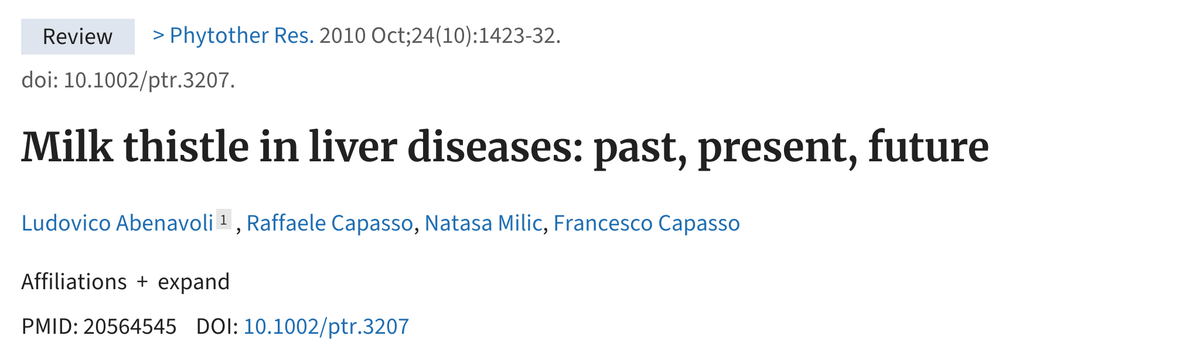
The research drew the following conclusions:
- Milk thistle makes toxins and pollutants in the liver veins harmless
- It prevents toxins from entering the liver cells
- It regenerates liver cells that have already been damaged
- It stimulates the flow of bile through the liver’s bile ducts
- It supports the liver in its detoxification function, especially when milk thistle is combined with artichoke
That brings us to the second plant:
Artichoke:
Most impressive is this study, which attributes a hepatoprotective effect to artichoke leaf extract (3):
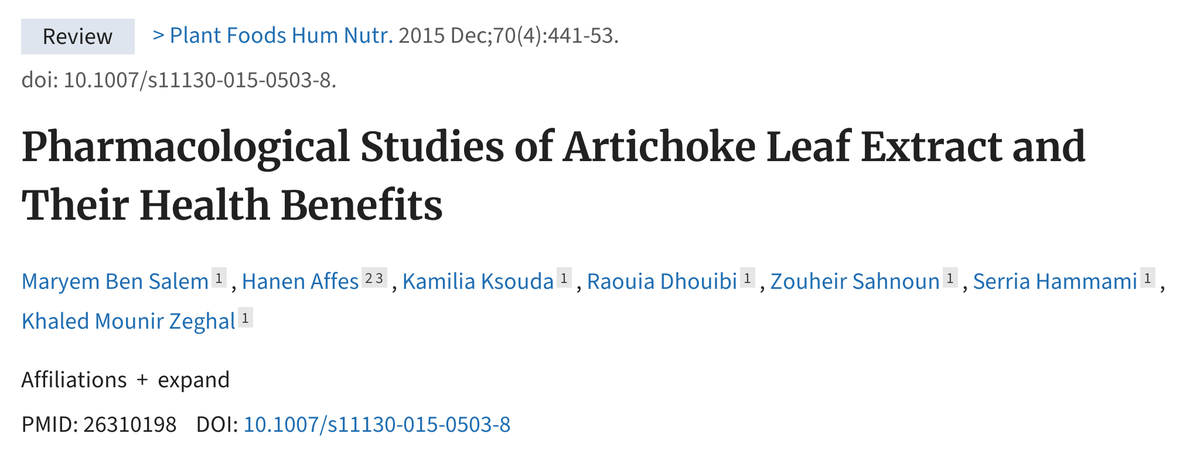
This means artichoke protects liver cells and stimulates them to regenerate.
In his book “Medical Medium Thyroid Healing” (yes, I devoured that one too during my research), Anthony William goes one step further.
He stresses that artichokes contain many as yet undiscovered compounds that work specifically for the thyroid.
These compounds, especially the secondary plant substances in artichoke leaves, are effective at shrinking nodules, growths and cysts in the thyroid.
Thanks to these two medicinal herbs, milk thistle and artichoke, the liver is protected and strengthened in its function.
Almost at the push of a button.
And then the rule applies:
A liver full of energy makes a person full of energy.
But as I mentioned, that alone isn’t enough.
A strong liver is the foundation, but it also needs the right building blocks to be able to convert T4 into T3.
And this is where step 2 comes in.
Step 2: Micronutrients for conversion
For the conversion of T4 into T3 in the liver to happen at all, your body needs very specific nutrients.
Without these nutrients the liver is like an engine that is running but, without fuel, won’t move an inch.
During my research, two nutrients came up again and again.
Two nutrients that are directly involved in conversion and that are almost never checked by a doctor.

Selenium:
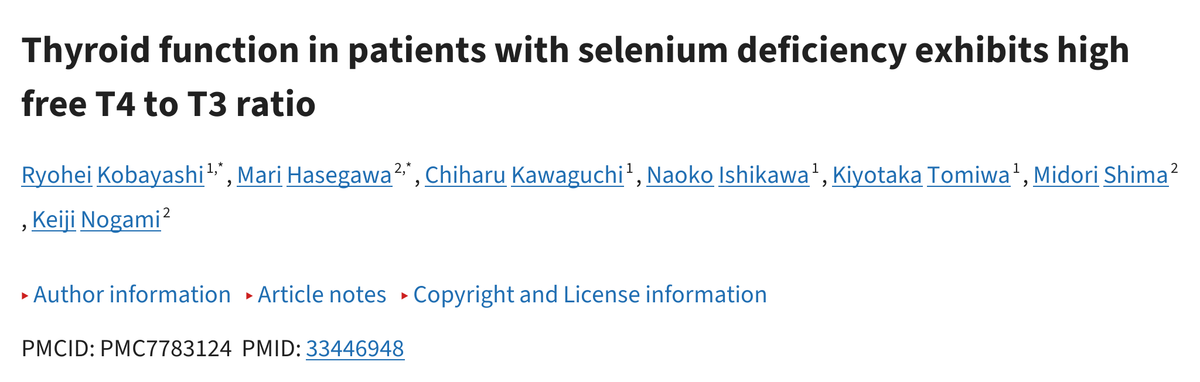
Study shows: a selenium deficiency can lead to a conversion disorder
Selenium is directly involved in the conversion of hormones in the liver.
Because the enzymes that convert T4 into T3 are built with selenium.
But selenium can do much more.
As a cofactor it is already involved in the production of thyroid hormones.
So selenium is an absolute must for anyone with an underactive thyroid.
Especially as many people in the UK have a low selenium intake:

Glutathione:
Glutathione is the most abundant and a very powerful antioxidant in the body.
In its active form it is able to neutralise free radicals.
Normally glutathione catches these free radicals and so protects our cells.
But when there are too many free radicals, glutathione gets used up.
The technical term is that glutathione is “oxidised” (used up).
Once it is used up it can no longer help, and the cells and their power stations are more easily damaged.
And indeed, studies show that people with Hashimoto’s, for example, have less than half the serum glutathione (GSH) of healthy people (4).
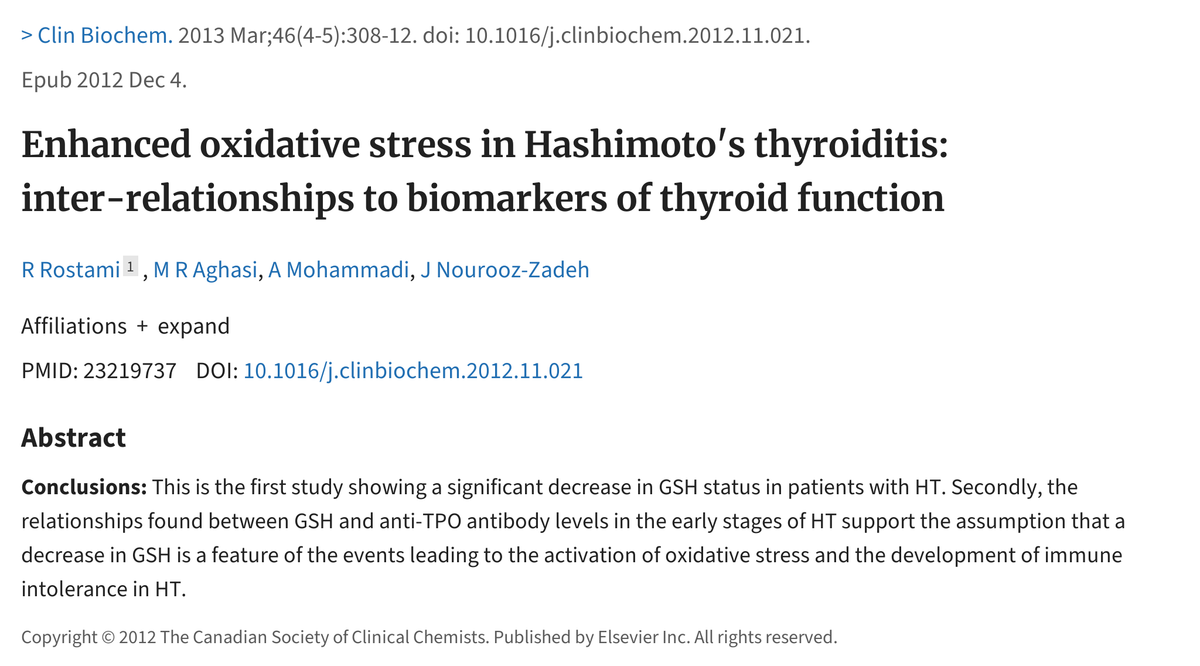
Yes, you read that right!
Less than half the glutathione! (GSH)
That is why it is so important to supply glutathione, to restore the balance between oxidative stress and antioxidants.
No doctor ever told me about glutathione, even though the research is clear.
But that’s not all:
Glutathione is one of the few nutrients (along with selenium) that has a direct effect on the conversion of T4 into T3.
This was discovered in this study:

It found that people with impaired conversion almost always have low glutathione levels (5).
So glutathione is a very important nutrient that most people lack for optimal conversion of hormones.
At the same time it is the blood value that almost every doctor overlooks and usually doesn’t even test.
As you can see, glutathione is one of the most important nutrients for treating a conversion disorder.
But glutathione alone isn’t enough
You are probably thinking now:
“Then I’ll just take a high dose of glutathione and that’s that.”
That’s exactly what I thought too. But unfortunately it doesn’t work that simply.
Because in high doses glutathione is poorly absorbed by the body. You simply excrete most of it.
But there is a much better way.
Help your body make its own glutathione
Your body can also make glutathione completely on its own.
All it needs are the right building blocks.
And these very building blocks are missing in most people.
The three most important are:
Cysteine
NAC (N-acetylcysteine)
L-methionine
If you give your body these three building blocks, it will make glutathione from them itself.
And exactly the way it needs it.
That is always better than simply swallowing glutathione in a tablet.
A nice side effect that particularly pleased me:
In several studies L-methionine has even shown a positive effect on hair loss.
For every woman with an underactive thyroid who suffers from thinning hair, that is a real bonus.
My list was finally complete
After two weeks of intensive digging I finally had a list in front of me:
- Milk thistle
- Artichoke
- Dandelion
- Selenium
- Glutathione
- NAC
- L-methionine
Seven substances I would have to buy separately.
I did a quick calculation.
Over £90 a month.
At least.
That was a lot of money.
But after 20 years of struggling I had nothing left to lose.
So I ordered everything.
Because according to the research, my liver would finally be working at full capacity again.
T4 gets converted into T3 and metabolism gets going.
That way, symptoms such as hair loss, tiredness and sleep problems were finally supposed to improve.
My self-experiment
Before I even started taking all these supplements, I made a decision:
I wanted to see in black and white whether they really did anything.
No fooling myself.
No “I think I feel better”.
Just real numbers.
So the next morning I went to my doctor and had a full blood test.
This time not just TSH, which my doctor had always been happy with.
But everything that really matters.
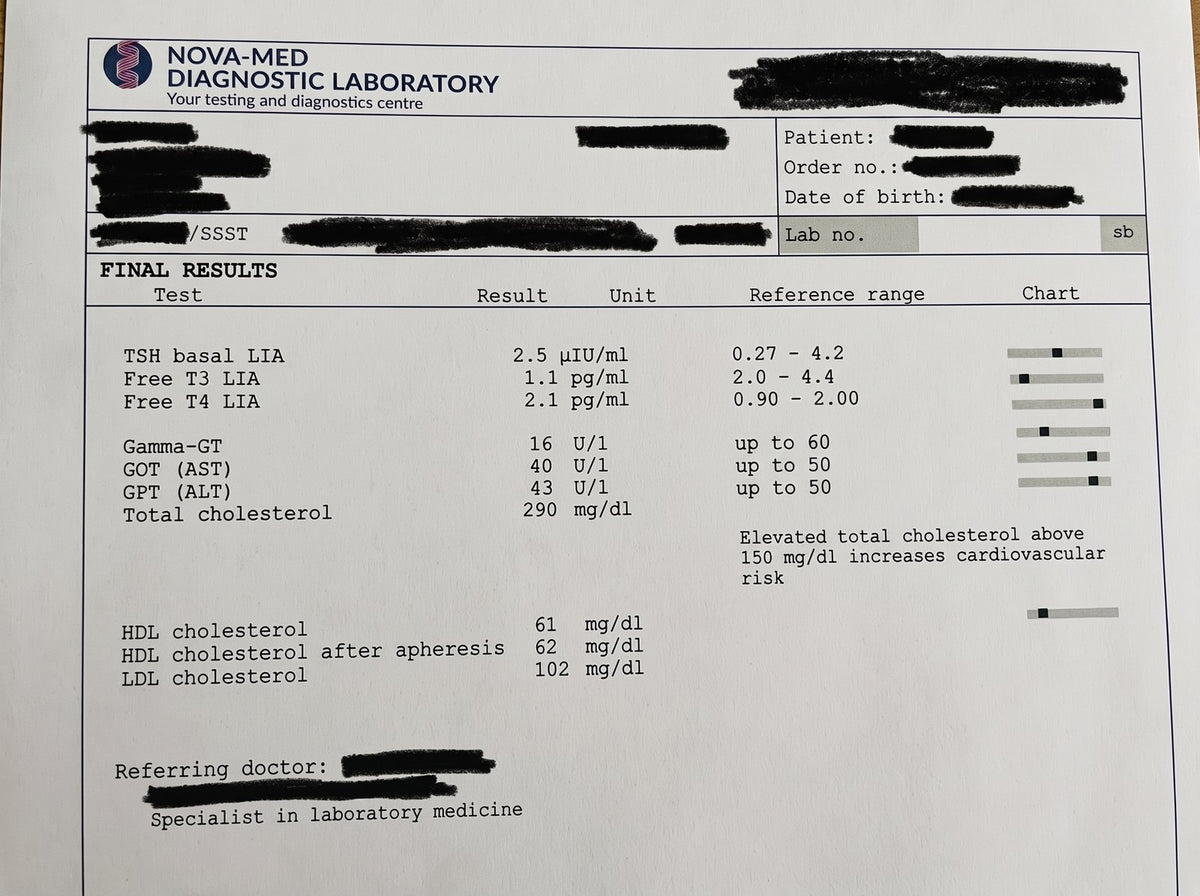
My blood results BEFORE the experiment
When I saw the results, I finally had clarity.
My TSH was indeed still “normal”.
And that was exactly the problem.
Because UK guidelines say that for the thyroid, doctors should go mainly by the TSH value.
So my doctor had done everything “right”.
By the rules.
The only problem is that these rules are flawed.
Because the TSH value says nothing about whether enough active thyroid hormone is really reaching your cells.
What really matters is the T3 value, the active hormone that powers your body with energy.
And that is exactly the value that hadn’t been measured in 20 years.
Until now.
And the result was frightening:
My T3 was catastrophically low.
Exactly what Bianco described. My body had T4, but no T3.
And my cholesterol was too high as well.
Suddenly everything made sense.
Everything the experts had said in the podcast. Everything I had researched for two weeks. Everything I had felt in my own body for 20 years.
I had the proof in black and white in front of me:
I had a conversion disorder. Just like millions of other women.
And the craziest part:
In 20 years not a single doctor had shown me these results.
Not one had measured my T3.
They all only looked at the TSH value and said:
“Everything’s fine, Mrs Krawiecka.”
For 20 years…
But anger won’t get me anywhere.
If nobody had acted for me in 20 years, I had to do it myself. Better late than never.
I had my list.
I had my substances.
And for the first time in years I had a plan again.
So I got started.
The first days were a nightmare
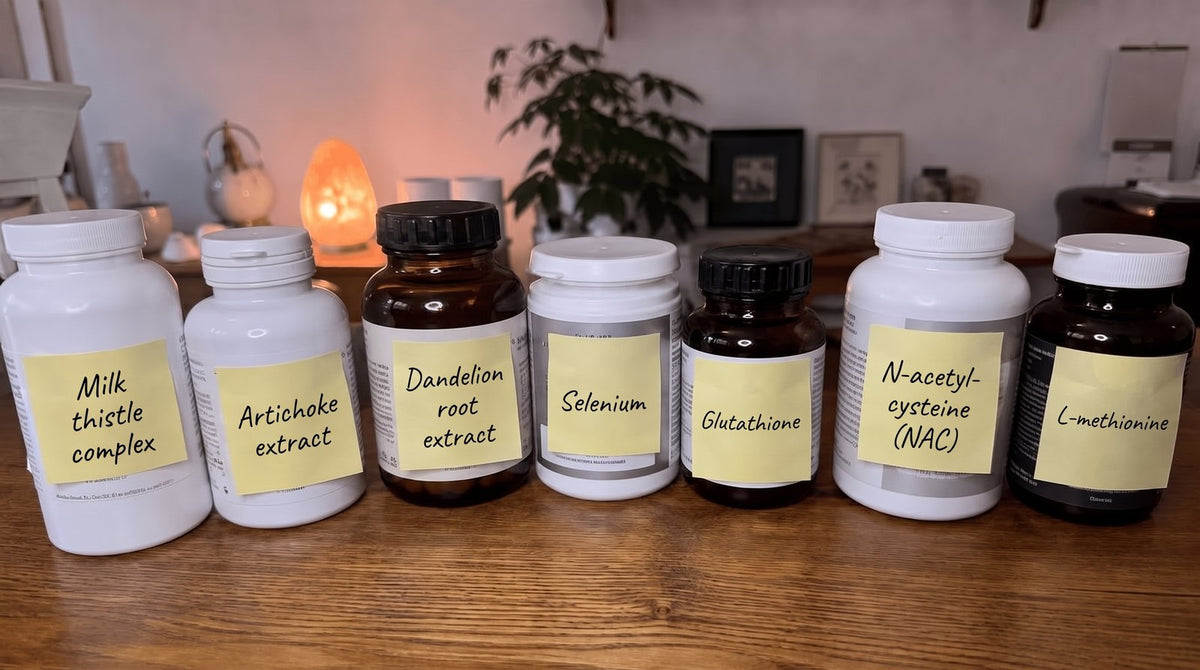
I started with all seven supplements.
Seven different capsules. Every day.
My table looked like a shelf in a small pharmacy.
Seven little jars.
Each with different instructions.
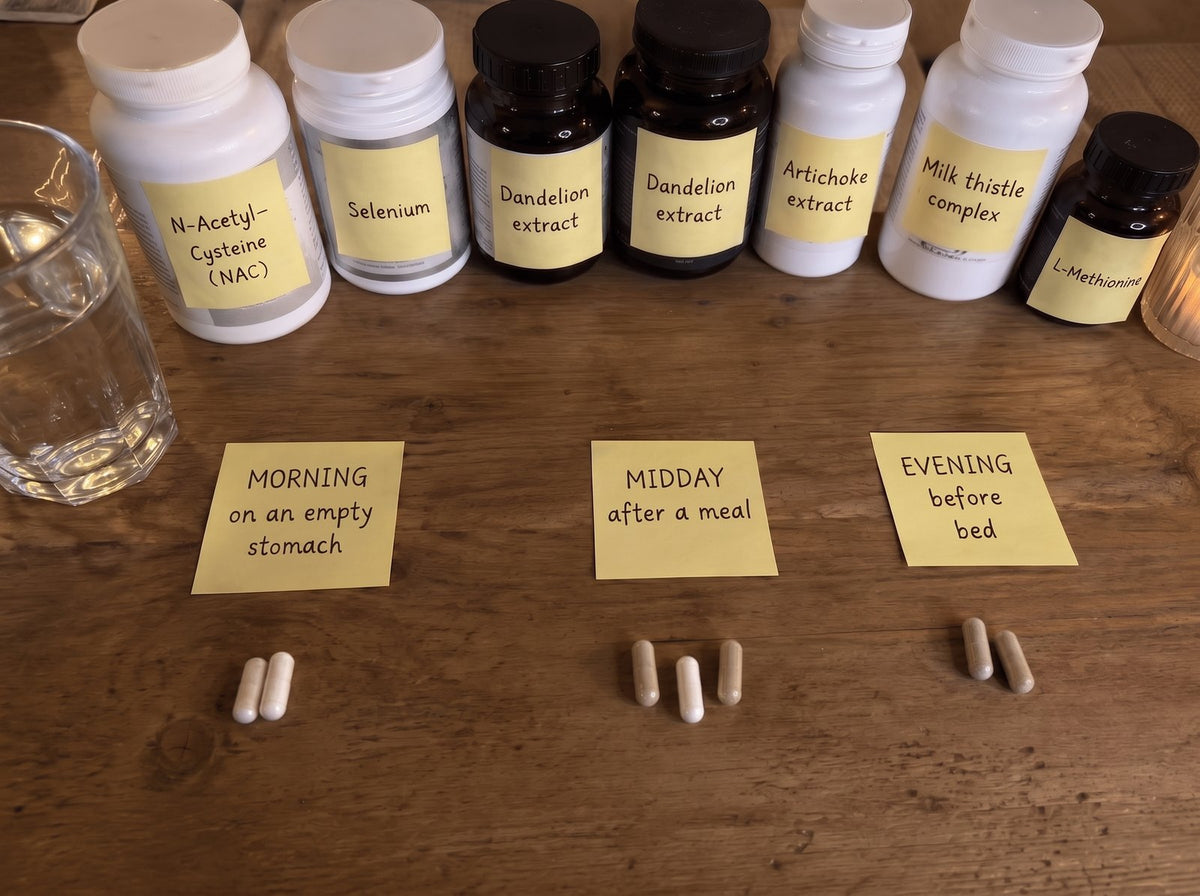
One before food, another after, a third ideally in the morning on an empty stomach.
Swallowing them all in the morning took five minutes.
My husband just shook his head at me:
“You won’t even last two weeks like this.”
But I was stubborn.
After 2 weeks something happened
Suddenly I slept through the night.
For the first time in years I didn’t wake up at three in the morning.
No racing thoughts.
No dragging myself out of bed exhausted in the morning.
I simply woke up.
Rested.
It was so unexpected I could hardly believe it.
My husband asked at breakfast:
“You seem somehow more awake today.”
For the first time in a long while I smiled a real smile.
After 4 weeks my midday slump was gone
Anyone who knows me knows: my afternoon slump was legendary.
Every day at 2 pm I fell into a black hole.
I could barely concentrate at my desk and just dragged myself through the afternoon.
After four weeks it had simply gone.
I was sitting at my desk at 3 pm, alert and focused, and suddenly realised that my afternoon slump was over.
It had simply gone.
But then there was a problem
Even though I felt better and better, my own mix was a nightmare in everyday life.
Seven different times to take things.
Seven different doses I had to coordinate. Some substances don’t work well together when taken at the same time.
NAC, for example, is extremely hard to get hold of: ordinary chemists don’t stock it, and good quality NAC is really expensive.
With some capsules I had to be careful to take them on an empty stomach. With others, with food.
I quickly lost track.
And my bank balance did too.
Over £90 a month.
I thought: there has to be a better solution.
The last piece of the puzzle
One evening I was on a thyroid forum where women share their experiences.
And one name kept coming up: Calveya.
A woman from Leeds: 4 kilos lighter after three months.
Another: her hair is growing back.
I was sceptical.
After everything I had been through in 20 years, I was wary of every new “miracle cure”.
But as a journalist I was also curious.
So I started digging.

Calveya is a young brand, and its Thyro Balance was created for one purpose:
to support people living with an underactive thyroid or Hashimoto’s.
They developed a product whose name says it all:
Thyro Balance.
The name alone made me curious.
Who calls a product that unless they have understood exactly what it’s about?
I looked at the ingredients:
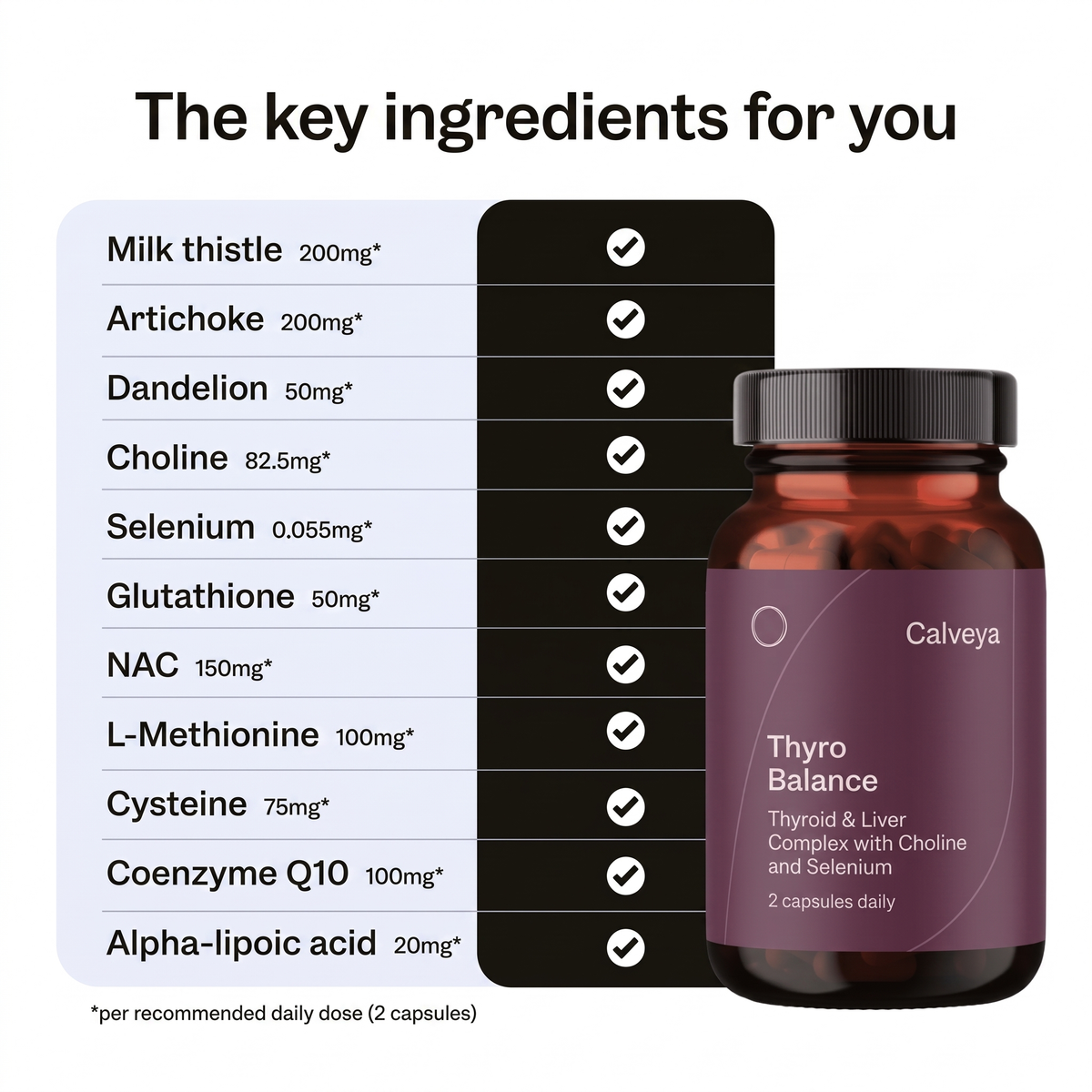
What I saw made me sit up.
Thyro Balance contained all seven of my substances.
It was basically exactly my own mix, except I didn’t have to put it together myself.
And on top of that there were a few extra ingredients I had come across during my research but had ultimately left out of my own mix because they would have been too expensive and too hard to get hold of separately.
And the price?
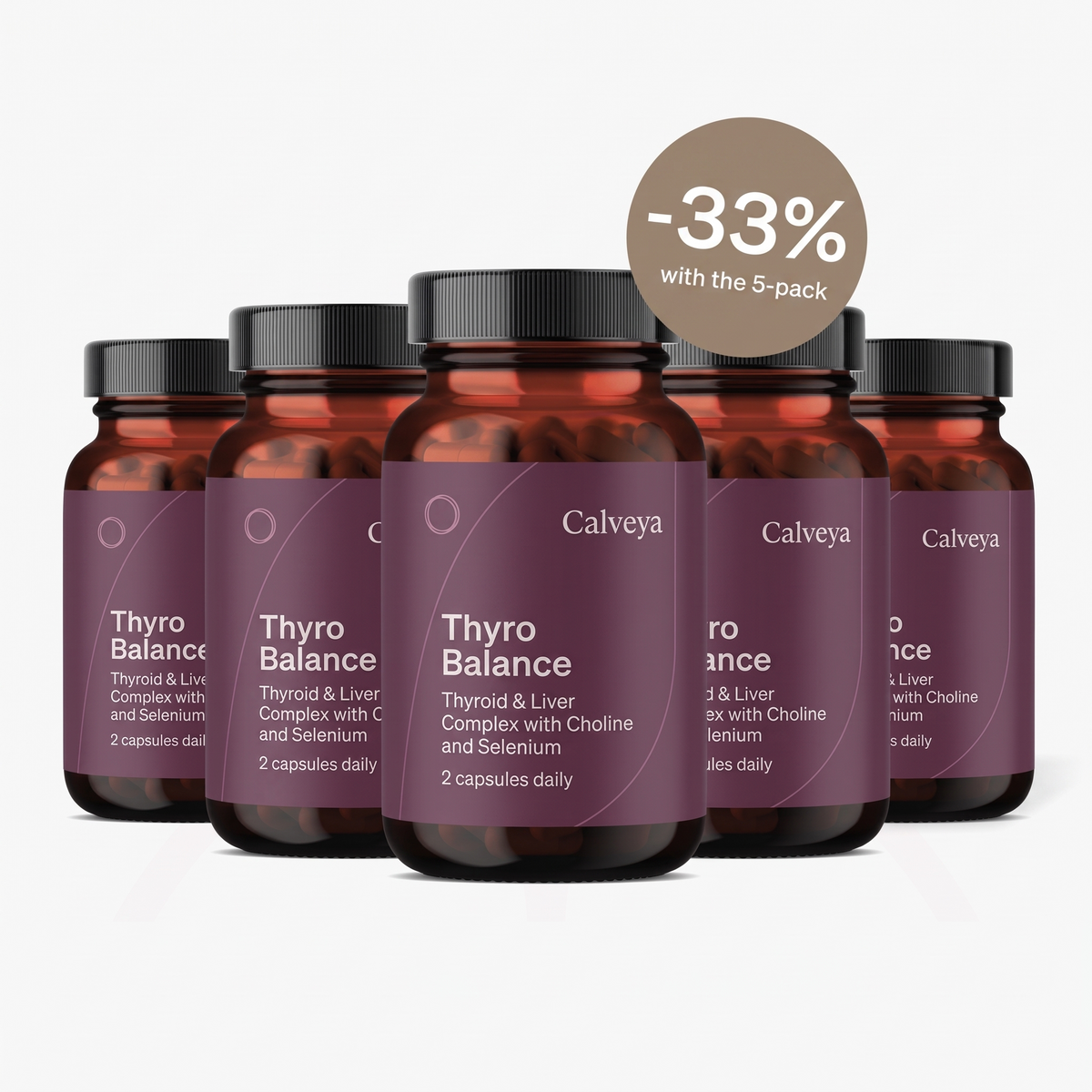
With the 3 jar pack: only about 87p a day.
Let that sink in
For my seven separate supplements I was paying over £90 a month.
Thyro Balance cost less than £26 a month with the 3 jar pack.
Less than a takeaway coffee a day!
That same evening I ordered the 3 jar pack and decided to continue my experiment from the second month with Thyro Balance.
Instead of taking seven capsules a day, I now only need to take 2 capsules, simply with a meal.
But does it really work?

After 8 weeks
I could hardly believe it myself.
The first 3 kilos had gone.
No diet. No exercise. Simply because my metabolism was finally working again.
My favourite jeans, which had been hanging at the very back of the wardrobe for three years, fitted me again.
I stood in front of the mirror for ten minutes, turning this way and that.
My husband came into the room, looked at me and said:
“You’re glowing.”
These were little things. But after 20 years, these little things were EVERYTHING to me.
After 4 months: second blood test
After three months the three jars of Thyro Balance were empty, so I went back to my doctor and had my blood taken again.
This time with my heart pounding.
Would the results confirm what I was feeling every day?
A week later I held the results in my hand:
My T3 (the value that had been at rock bottom for 20 years) was finally in the optimal range.
My selenium had risen from “deficient” to “optimal”.
My cholesterol was below 200 for the first time in 10 years.
I sat in the car in the surgery car park and cried.
But this time not out of despair.
This time out of relief.
My life today
In total I’ve lost 6 kilos.
My hair is so thick again that I can do a proper ponytail in the morning.
Colleagues at work ask me about it:
“Lina, what are you doing differently? You look amazing.”
I can work with focus right into the evening again.
No afternoon slump.
No more cotton wool feeling in my head.
I sleep through the night.
Every night.
I wake up without an alarm at seven in the morning.
And the most beautiful thing:
My husband touches me again in the evenings.
He puts his hand on mine when we sit on the sofa.
He kisses me before we fall asleep.
After 20 years I finally recognise myself in the mirror again.

My research became the biggest article of my career
I wrote the story.
Just as I have told it to you.
My boss was stunned. The cover story went off like a bomb.
Instead of being let go, I was promoted.
In the weeks after publication I received hundreds of letters and emails from readers sharing their own stories.
I only want to show you three of them:
Dear Lina Krawiecka,
I still can’t believe how quickly I felt an improvement.
In the middle of the menopause I was diagnosed with an underactive thyroid. I had no idea where my usual energy had gone.
After your article I ordered Thyro Balance. In a very short time it gave me back my energy, and my good mood too.
After my initial doubts that such a quick change could be possible, after two weeks I’m completely convinced. I haven’t changed anything else.
Thank you so much for this article. It changed my life.
Maggie Newman
Dear Lina Krawiecka,
I’ve been taking Thyro Balance for about 4 months now, and your story was what prompted me.
After 2 months I clearly noticed that my afternoon tiredness was less and my irritability had eased a lot. Overall I feel better and have more strength.
I’ve been taking levothyroxine 100 micrograms for 2 years and have my results checked regularly.
I’ve just had another blood test and imagine: my TSH has dropped from 1.7 to 0.54.
Lina, thank you from the bottom of my heart.
With warm regards,
Katherine Woods
Dear Lina Krawiecka,
I have Hashimoto’s at a fairly early stage. My results weren’t really bad yet, but I had to take levothyroxine and I simply didn’t feel well.
When I read your article, I decided straight away to order Thyro Balance.
Incredible. I would never have thought the effect could be so clearly noticeable.
Without your article I would still be that tired person with no energy today.
Thank you, Lina! You saved my life.
Gratefully,
Monica
These letters moved me deeply.
And they are the reason I’m writing this second article, the one you’re reading now.
Because I know what you’re going through right now.
I know what it’s like to wake up tired every day.
To feel like a stranger in your own body.
To stand in front of the mirror and not recognise yourself.
I know what it means when doctor after doctor tells you:
“But your results are normal.”
And I know what it’s like when you finally feel like yourself again.
And that is exactly what I want to help you with.

One more thing you need to know
I’m writing about this because I believe in this method and because it helped me and hundreds of my readers.
I wrote this article for just one person:
For you.
But I also understand if you’re sceptical.
Honestly, in your shoes I would be sceptical too.
After all those expensive supplements that did nothing.
After all those doctors who didn’t listen to you.
That is exactly why there is a 60-day money-back guarantee.
No ifs, no buts.
If Thyro Balance works for you, you get your old life back.
If it doesn’t work, you get every penny back.
So you have nothing to lose.
An exclusive discount for my readers
Because I’m sharing this story with you, I negotiated an exclusive magazine discount for my readers with the manufacturer.
You only get this discount through this article, not in the regular online shop.
This means Thyro Balance costs you only about 87p a day with the 3 jar pack.
Less than a takeaway coffee.
Something that could give you back your energy for life, for the price of one coffee.
My personal advice to finish:
If you wake up exhausted… every morning, even after 8 or 10 hours of sleep
If you put on weight even though you hardly eat anything… If you have sleep problems and your joints ache…
If for years you have been going from doctor to doctor and nothing really helps…
Then you need to understand something important now:
Nobody will help you unless you start yourself.
No doctor.
No partner.
No miracle.
Only you.
You now have two options.
Option 1:
You carry on as before.
You keep going to doctors who tell you your results are normal.
Who stick to guidelines that are no longer up to date.
Who prescribe you a higher dose of thyroid medication year after year.
And you accept that you feel worse month after month and, in the worst case, even develop related conditions…
High blood pressure, diabetes, depression or weaker bones.
Because an untreated conversion disorder wrecks your whole body over the years.
Option 2:
You take responsibility.
For your body. For your life.
For the person you once were.
You try the approach that gave me and hundreds of other women our lives back.
An approach that doesn’t fight your body but supports it, so it can finally do what it was made to do again.
Which path you choose is up to you alone.
But please remember:
You only have this one life.
And you deserve to finally feel good in it again.
With love, Lina Krawiecka
A quick note:
Thyro Balance has sold out regularly in recent months. Unfortunately I can’t promise it will still be available today.
What I like about Thyro Balance:
1) Delivery is free and the packaging is carefully prepared.
2) The capsules are easy to take: you just take them with a meal.
3) You can save a lot with the 3 jar pack. Either way, it’s worth giving it a chance for at least 3 months.
What I like less:
1) Unfortunately the NHS doesn’t cover the cost.
2) The product is only available online and (not yet) in my local pharmacy.
3) It’s relatively expensive, but you can save a lot by stocking up straight away. It’s worth giving it a chance for 3 months anyway.
Verified reviews
Here I’ve picked out some more reviews of Calveya and Thyro Balance for you:
I’ve been taking Thyro Balance for 30 days now. The first jar is empty and I feel better, calmer and I sleep much better.
As I’ve been trying to get back to a weight I feel good at for years but have mostly only gained, I naturally hope something changes on that front too.
At least the upward spiral has been broken for now, and I’m less hungry and need less food. Maybe that will show on the scales soon? That would be nice. I’ll report back.
I’ve been taking Thyro Balance for a good 3 weeks now and I definitely feel a bit fitter and more resilient. I’ve already ordered my 2nd jar and can’t wait to see what happens next.
After about 1 to 2 weeks of taking one tablet a day, I can say that I feel more awake and fitter and have more strength.
Hello lovely people,
Thank you for asking. I’m doing really well now thanks to your Thyro Balance. I would never have thought it could happen so quickly. I’m feeling almost as full of energy as I used to before my thyroid started to struggle. I really want to thank you, it helps people so much, because my doctor never explained anything like this to me. Only because I wanted to find out more myself did I come across you on the internet. Thank you again. In September I have my blood test, let’s see what my TSH comes out at. I can tell you, I feel great.
It takes a while before something happens. I take the capsules together with essential amino acids. After 4 weeks I started to lose weight, my nails are softer and I no longer feel so tired. I also naturally keep making an effort with my diet.
Addendum
Since I published this article, many of you have asked questions. So I wanted to briefly answer the most important ones:
Who is Thyro Balance best suited for?
If one or more of these points apply to you, Thyro Balance will very likely help you:
- You already take thyroid medication but don’t feel any improvement
- Your fT4 is fine but your fT3 is very low
- Your rT3 is very high
- You have a fatty liver or a very weak liver. Signs of this can include pressure in the upper abdomen, needing to urinate at night, a feeling of fullness and bloating, and loss of appetite.
- You have high cholesterol and/or triglycerides
- You have little or no thyroid tissue left and depend on thyroid medication
Should I keep taking my thyroid medication alongside Thyro Balance?
Yes, definitely! Please don’t stop taking your medication. Thyro Balance is not a medicine for hypothyroidism.
The manufacturer recommends taking Thyro Balance in addition to your medication. Never change your medication without talking to your doctor, and have your thyroid levels checked regularly.
How can Thyro Balance help with weight problems?
Weight problems usually come down to a slow metabolism.
Metabolism problems, like most other symptoms, are in turn linked to too few active thyroid hormones reaching the body’s cells.
By improving the conversion of T4 into T3, you will improve your metabolism too.
How can Thyro Balance help with hair loss?
Hair loss often happens because too little active T3, the effective thyroid hormone, reaches the hair follicles.
Without enough T3 the body lacks the energy to make keratin and maintain the natural hair growth cycle.
Thyro Balance specifically supports the conversion of T4 into T3 by relieving and activating the liver, exactly where this process mainly takes place.
This way your body gets more of the hormone it needs for strong, healthy hair again.
Can I take Thyro Balance if I no longer have a thyroid?
Yes, absolutely. Thyro Balance contains only natural ingredients. Especially if you no longer have a thyroid, it is all the more important that the T4 you take can be converted better.
Can I take Thyro Balance if I have Hashimoto’s?
Yes, even then it makes sense to support your body in converting thyroid hormones.
What’s the best way to take Thyro Balance?
The manufacturer recommends taking 2 capsules after the first meal of the day with a glass of water. It is important to leave 2 hours between Thyro Balance and your thyroid medication.
How is Thyro Balance different from essential amino acids?
Essential amino acids are very important with an underactive thyroid, but they aren’t enough. For example, amino acids alone have no effect on the liver. Thyro Balance also contains essential and semi-essential amino acids, specifically the ones needed to produce glutathione, and therefore to convert thyroid hormones.
On top of that, Thyro Balance stands out with highly effective ingredients for liver health: milk thistle, artichoke, dandelion root and choline.
How long does it take for the product to work?
Most customers report a first noticeable improvement after just 3 days. Thyro Balance reaches its full effect after about 2 months. That’s how much time you should give your body.
How long does one jar last?
One jar contains 60 capsules, so it lasts exactly 30 days.
Is there a guarantee?
Yes, Calveya offers a 60-day money-back guarantee. So you can try it risk-free: if you are not 100% convinced by the effect, simply email contact@calveya.com.
Is the manufacturer trustworthy?
This question keeps coming up, as there isn’t much information about Calveya online yet.
What I can say: the customer service was very friendly. There are also customer reviews on the product page.
Overall, the company makes a very trustworthy impression on me.
Sources (original English studies):
(1) Hasegawa, Mari. 2021. “Thyroid function in patients with selenium deficiency exhibits high free T4 to T3 ratio.” NCBI. https://www.ncbi.nlm.nih.gov/pmc/articles/PMC7783124/
(2) Saller, R., Meier, R., & Brignoli, R. (2001). “Milk thistle in liver diseases: past, present, future.” Phytomedicine: International Journal of Phytotherapy and Phytopharmacology, 8(5), 387-395. https://pubmed.ncbi.nlm.nih.gov/20564545/
(3) Ben Salem, C., Ben Rayana, M. C., Slim, R., Fathallah, N., & Hmouda, H. (2015). Pharmacological Studies of Artichoke Leaf Extract and Their Health Benefits. Phytotherapy Research, 29(11), 1589-1606. https://pubmed.ncbi.nlm.nih.gov/26310198/
(4) Rostami, R., Aghasi, M. R., Mohammadi, A., & Nourooz-Zadeh, J. (2013). Enhanced oxidative stress in Hashimoto’s thyroiditis: Inter-relationships to biomarkers of thyroid function. Clinical Biochemistry, 46(4-5), 308-312. https://pubmed.ncbi.nlm.nih.gov/23219737/
(5) Goswami, A., & Rosenberg, I. N. (1988). Effects of glutathione on iodothyronine 5′-deiodinase activity. Endocrinology, 123(1), 192-202. https://pubmed.ncbi.nlm.nih.gov/3383773/
(6) Hotze, L.-A., & Schumm-Draeger, P.-M. (2003). Thyroid diseases: diagnosis and therapy (Schilddrüsenkrankheiten. Diagnose und Therapie). Berlin: Verlag für Medizin Dr. E. Fischer. ISBN 3-88040-002-4.